Today’s post is more “Learning Out Loud” than Thinking Out Loud. I’m translating newly learned technical language into concepts that feel practical and usable for me and Spark.
When it comes to Net Zero journeys, it’s true that I’ve been a bit of a sceptic about how Spark can contribute to climate change reduction.
We’re not in the highest-emitting industries, such as energy (75%), agriculture (11%) or industrial processing (7%).
We’re classed as a “micro-business” by HMRC (less than 10 employees).
Without putting a ceiling on our ambition, is it likely that Spark will be around in 24 years, in 2050, to achieve Net Zero?
After talking it through with friends and colleagues, I’ve come to the position that, much like Tesco says, every little helps. And as Heart of the City puts it, “every business can be a force for good”.
There’s always room for improvement in our own work. Asking our suppliers about their plans may offer an opportunity for change. Perhaps talking about our efforts and progress can inspire someone else to make a different choice.
Equipping ourselves with knowledge and tools
Today was the kick-off session for Heart of the City’s Net Zero programme.
As participants, we were invited to share why we’re here. Here’s what I shared:
I want to be able to talk confidently about all the different terms.
Two years ago, we received consultancy support to create a baseline for our emissions. It was very detailed, across each single line of expenditure. While it gave us the “answer”, I didn’t feel confident to talk about it, let alone knowing how to do it ourselves.
I want to gain the tools and knowledge to be able to measure emissions ourselves. Even if this was “just” top-line measures to start, I wanted to feel capable of adding more granularity later on.
After some teaching moments, participants were given a quiz about six terms. I’m using this blog to explain them in my own language, to help them stick in my mind.
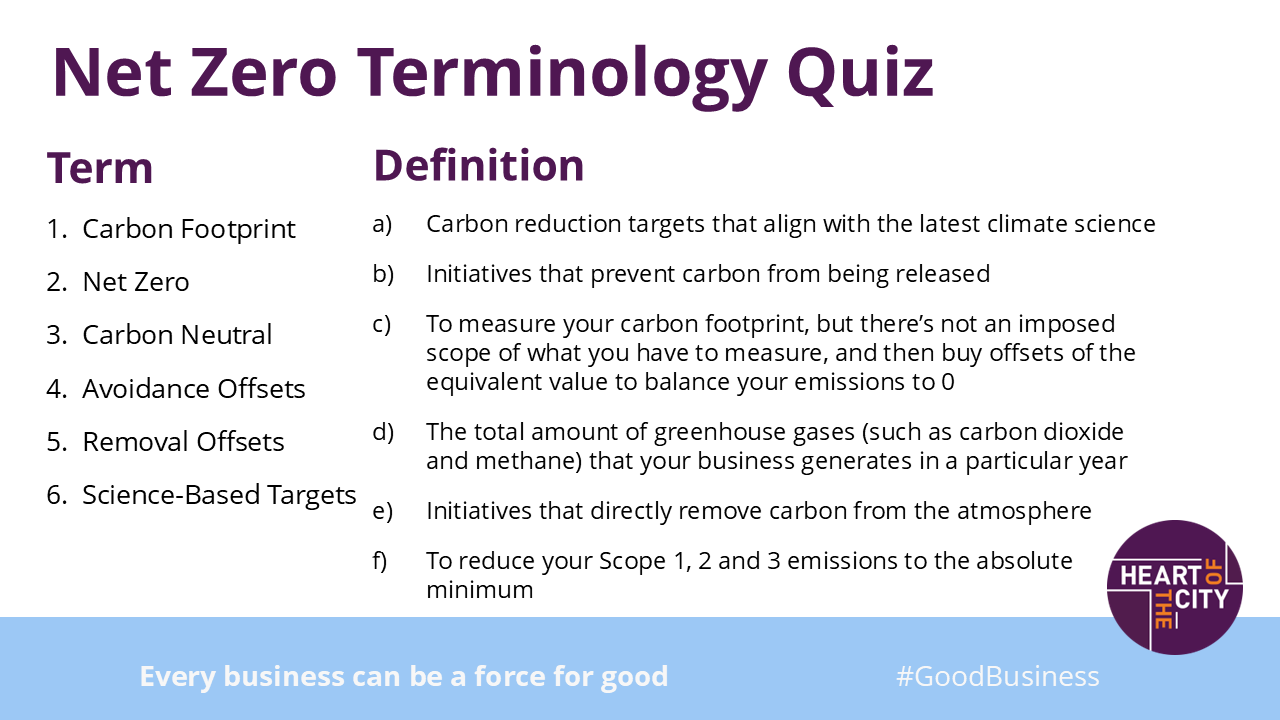
A slide from Heart of the City’s Net Zero programme, used here as a learning prompt (shared with permission).
Carbon Footprint = what we emit
= (d) The total amount of greenhouse gases (such as carbon dioxide and methane) that your business generates in a particular year.
What this means: there is an environmental impact to the work we do. The power we use for heating, lights, for laptops. The paper we write on, print workshop materials with and create visual boards from. The transport we use for in-person meetings, and how goods for our office reach us (such as cleaning products, office furniture and coffee).
Net Zero = reduce first, offset last
= (f) To reduce your Scope 1, 2 and 3 emissions to the absolute minimum.
What this means: Net Zero is about reducing our emissions across all three Scope categories to the absolute minimum possible, and by 2050, to 10% or less of our baseline footprint (taken in 2024).
The difference between the three Scope categories is the level of control we have over the decisions:
Our Scope 1 emissions are DIRECT emissions, like our studio space and any company vehicles (which we don’t have).
Our Scope 2 emissions are INDIRECT emissions from purchasing electricity and heating that we use to run Spark’s studio.
Our Scope 3 emissions are INDIRECT emissions from upstream activities such as commuting, travel, goods and services, and downstream activities such as how the physical and digital materials we create are used, stored and eventually disposed of (or securely destroyed).
Carbon Neutral = measure + offset, looser scope
= (c) To measure your carbon footprint, but there’s not an imposed scope of what you have to measure, and then buy offsets of the equivalent value to balance your emissions to 0.
What this means: this took a while to get my head around.
We measure the emissions we directly and indirectly produce because of the work we do at Spark.
There’s not a strict scope of what or how we measure it.
We can then buy “offsets” to counter the emissions we’ve created because of our work. Offsets can be “avoidance” or “removal” (see below).
Carbon Neutral can be an interim goal on the way to Net Zero. And this is how we’ve approached our work so far (even if I didn’t realise it fully!)
Avoidance Offsets = stop emissions
= (b) Initiatives that prevent carbon from being released.
What this means: stopping more carbon being emitted. This could include supporting renewable energy infrastructure, cookstove projects and waste to energy facilities.
Removal offsets = pull back emissions
= (e) Initiatives that directly remove carbon from the atmosphere.
What this means: tree planting is a commonly known offset and we’ve supported this previously. There are also carbon capture technologies which I don’t know much about yet. I’m also reading about Direct Air Capture which physically remove CO2 from the air and stores it.
I’m also learning about seaweed and kelp farming. A good friend of mine in Maine has ambitions in this space, and it’s fascinating to see how carbon removal can come through very different forms, not just trees.
And a note: there’s a surge of carbon removal projects, and I’m learning that this can get tricky when projects damage biodiversity, displace communities and/or don’t genuinely add new carbon reduction. More to unpack here. Careful what we “buy” our way out of.
Science-based targets = direction of travel
= (a) Carbon reduction targets that align with the latest climate science.
What this means: the aim is to limit global warming to 1.5°C above pre-industrial levels.
By 2030 = a 50% reduction in emissions from Spark’s work.
By 2050 = a 90% reduction in emissions from Spark’s work.
This has felt challenging as we’re in a stage of growth for the business. It’s likely that our emissions are currently the lowest they will be.
A question arose: will we be penalised for growing our social impact by contributing to negative environmental impact?
What I’ve learned is that science-based targets don’t punish growth. They ask for clarity and honesty. We can measure emissions per FTE of staff, per project, or per £ of income, rather than pretending that growth isn’t happening.
Next steps
Our programme homework is to capture our 2025 emissions by Tuesday 3rd February.
I’ll share what I learn as we go.
Writing this out has helped the concepts and ideas become more tangible for me. If you’ve made it through to the end of this post, thank you!
Thinking Out Loud is where I share short pieces of thinking from the middle of the work. Ideas, questions and lived experiences, shared while they’re still forming. (Tiny Experiments Pact: Day 11/100).