In a conversation about the growth of opportunities for AI in public services today, this line came up:
“The public service is full of busy people doing messy work.”
One bit has been sticking in my head: the “messy” bit of the work.
The work for many in public services doesn’t follow industrialised processes and standard operating procedures (I would argue that there’s room for more SOPs, but that’s a conversation for another day).
It’s often relational.
It’s often supporting people in a moment or season of need. Sometimes it’s in, or after, a crisis.
Sometimes it’s when other avenues have become exhausted, even as system-level aspirations point toward more proactive, preventative support.
It’s messy.
It calls for ‘softer’ (and yet often harder-to-do) relational skills.
It’s navigating complex, opaque pathways and digital systems that don’t talk to each other.
It’s about coordination. About ensuring people’s needs don’t fall through the cracks. When they do, we sometime see the impact in high profile cases in the media. While many more will remain unspoken.
It’s this messiness that’s staying with me.
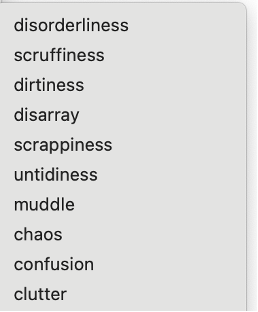
Synonyms for ‘messiness’
Out of curiosity, I asked Microsoft Word (where I draft my posts) for synonyms for ‘messiness’.
These include disorderliness, disarray, scrappiness, muddle, chaos.
Which is the language of deficit.
These words don’t capture the care, judgement and responsibility that go into the millions of decisions every day across our public services.
Which are messy, because they are relational, determined by many factors, and above all, human.
What’s the antidote here?
To remove the humans from the process?
Or, to improve the pathways, the underlying systems and processes, and data sharing – so that the humans can do what they do best: the human work of discernment and care (within regulated, appropriate boundaries), providing open, kind and fair interactions for all.
Thinking Out Loud is where I share short pieces of thinking from the middle of the work. Ideas, questions and lived experiences, shared while they’re still forming. (Tiny Experiments Pact: Day 12/100).